
Inclinations; rotations; chest impulses; transtations; tug-of-war; first illusory walk; facial exercises; improvisation #1; slow-motion exercise; duets.
Repeat the inclinations, the rotations, the chest impulses where the chest moves the arms, the transtations, and the tug-of–war. This time, in the tug-of war, allow the elbow to bend and the knees to bend, shifting the weight back and forth.
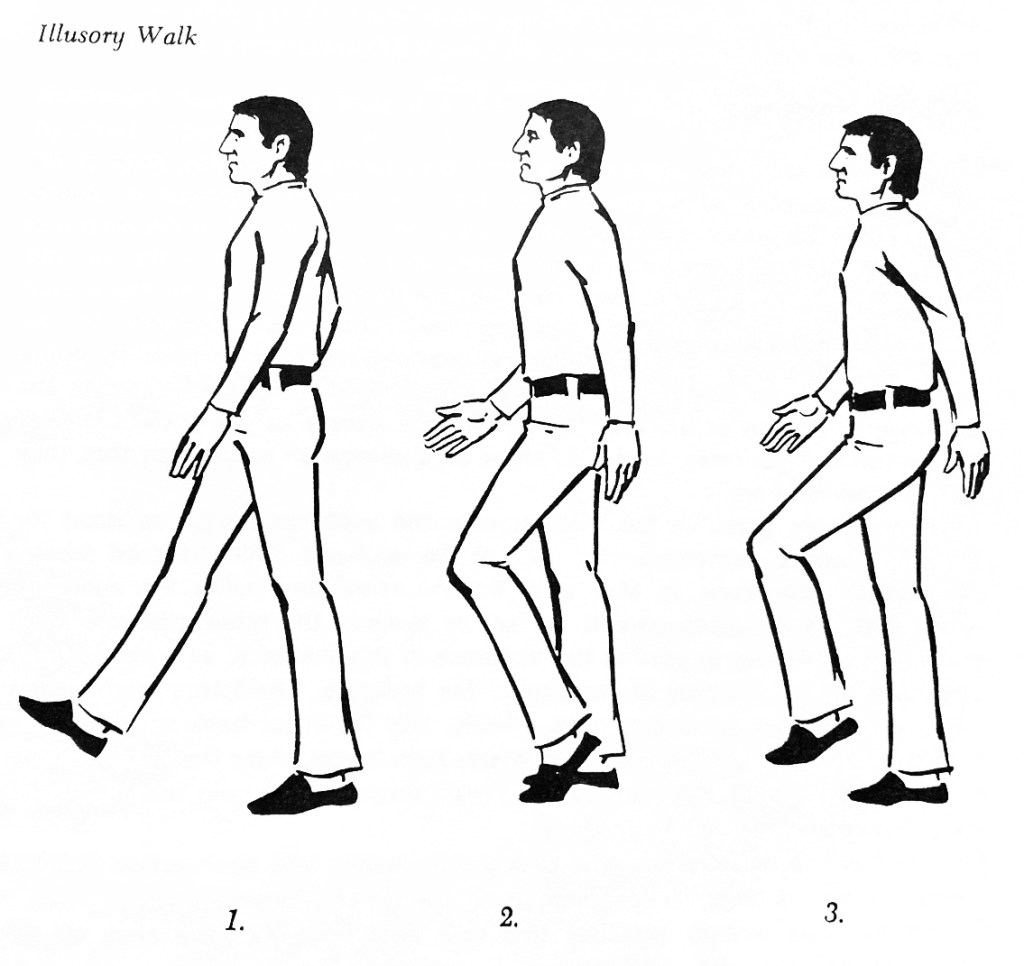
First Illusory Walk:
This walk gives the appearance of walking, while the per. former actually stands in one spot. It should be practiced in two halves, and then the halves can be put together to make the walk. Start with the right leg extended into the air, foot flexed, and knee straight with the heel about twelve or fourteen inches off the floor and with the left arm forward, the right arm back, hands below waist level, and the elbows rather straight. Now, as you pull in the right leg and put the foot on the floor, bend the left knee and go to the half-toe of the left foot; as you bring the right leg in, swing the right arm forward, and the left one back. Repeat this move from the starting position over and over. Then do it on the other side, with the left leg swinging in as the left arm goes forward, and going to the half-toe of the right foot. These are the two halves of the walk.
Now to complete it:
Start with the right leg extended, left arm forward, pull in the right leg, going to the half-toe of the left foot, and right arm going forward as before, ending with the right foot on the floor next to the left one, as before. Now, without moving the arms, lift the left foot into the air, from the half-toe, and extend it forward, with a kind of bicycle-peddling motion, until the knee is straight, and now you’re in the start of the other half of the walk. Pull the left leg in, going to the half-toe of the right as you change the arms and put the left foot down. Now lift the right in the circular motion, keeping the arm still, and keep going. The hard part is: Keep the arms in place while you lift the foot, and only change them when the leg pulls in straight. This will keep them in opposition to the knee that comes forward; it is hard at first, and feels unnatural, but becomes easier. Repeat the facial exercises.
Improvisation #1:
This improvisation embodies several principles; gaze at the audience, separation of action, and relating to an imaginary person or object. The form is: Walk onto the stage, stop; see a person or object in the direction you were walking (it can be straight ahead, on the ground, or in the air, but must be toward the wings), stop; react to it with some kind of an expression (not the ones we practiced—something real), show the expression to the audience, bring your head back, and then continue the improvisation by doing something to or in relation to the person or object. Showing the face to the audience is not part of the action, and the body freezes as you show it. It is a convention that you may do this to show an audience an expression that they cannot otherwise see. There are three gazes in the theatre: over the audience, which is used for houghts, images, remembrances, etc.; at the audience, which is used mostly by stand-up comedians, or M.C.’s, or for the aside; and below the audience vhich includes all gazes around the set or towards the other characters. In nime we are allowed to gaze at the audience in this instance, as a kind of fast :lose-up which is not part of the action. For instance, two actors might come into the stage, one advancing with a knife, and the other backing up. At the noment before the knife strikes they might both freeze, show their expressions o the audience, snap their heads back toward each other, and then the knife yould strike and the victim would die. Be sure this improvisation is done slowly and clearly, with each action finished efore the next is begun. Each member of the group should try this. 1o another slow motion exercise, this time with imaginary bananas on the able; peel and eat them, and throw the peel at the other person. ook at the homework assignment.
Duets:
Two people face each other, ten or fifteen feet apart, and walk to the enter, passing each other. They turn, and one of them (assigned by the ader) will start the scene, the improvisation. He can start with a character
relationship or an object, or a place, and the other person must go along with what is happening, and take his character, attitudes and actions from what the originator sets up. There is no talking in this. For instance, one student might sit in an imaginary chair, and motion for the other one to file his nails. The other one must then become a manicurist, and the scene proceeds from there. Or one may look at the other with adoration, and ask for an autograph by extending an autograph book and pen. The second person must now become a movie star, or a celebrity of some kind, and should accept the relationship that the first person established. This can go anywhere, and should not be limited by reality. One hint: Avoid conflict in all improvisations. Go with what is happening; agree rather than conflict. Conflict ends the scene; if you go with what is happening, it can go on, and you will find more things to explore. When it is over, have the two people switch roles, the one who followed will now originate another scene, with the former leader following. Let as many people in the group do these as there is time for.
Homework Assignment:
Bring in a short sketch with all movements motivated by chest impulses, and in which at least one object is handled.
 Julien's Art Works