
Hand Exercises:
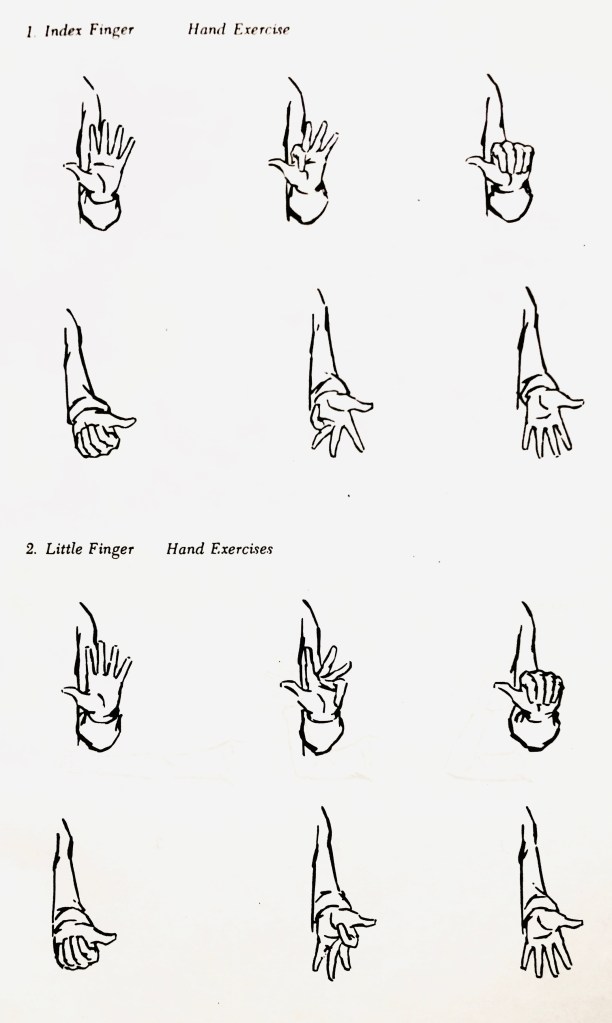
The purpose of the hand exercises is to provide strength and clarity to hand movements and gestures. To begin, warm up the hands by opening the hands as wide as possible, and then closing them tightly, alternating quickly, until you can’t do it any more. Next, put the fingertips together, lift the elbows high, and try to bend the fingers backwards, stretching all the knuckles. Now, open the palms wide, and face the hands straight forward. Touch the index finger to the palm and allow this movement to pull the next finger down to the palm, pulling the next one, etc., until they are all closed. As you close, try to keep the hands open, so that they stretch, and keep your thumb open. Now turn your closed hands over, and open them one finger at a time, index finger first, allowing each finger’s action to pull the next one smoothly. Now turn your hands back to the open facing forward position, and repeat it many times. Try to keep your hands closed as you open them, and open as you close them, so there is tension. Now try the opposite: Start with your hands open wide, and extended in front of you, palms up. Close the little finger first, as if you are grabbing something, and allow each finger to pull the next closed; the thumb stays open. Now turn your hands over, wrists up, and open little finger first, almost like you are describing two balloons in the air. Then palms up again, and close again, etc. Repeat this many times.
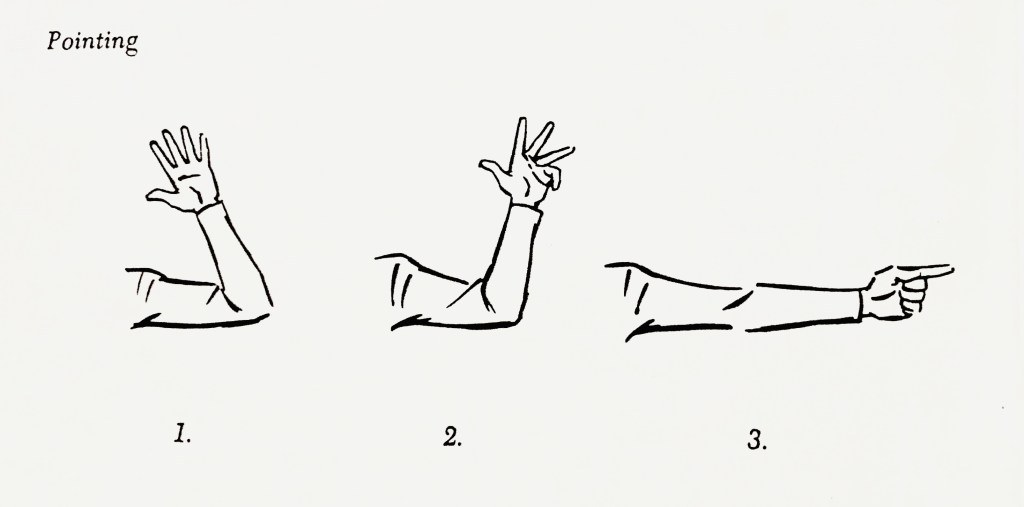
Pointing—
there is no one way to point; the following is a way among many, whatever is right for the character and the situation is the one to use. All pointing should be large and clear and done only once, never repeated, unless you point in a different manner. Lift your elbow to the side so that it is level with your shoulder, and have the lower arm pointing straight up at right angles to the upper arm, with the hand closed, and the index finger extended in a pointing position. Straighten the arm without moving the elbow, so the finger is now pointing. Be sure the wrist is locked and remains straight in line with the arm. Repeat this point with each arm, and then do it to the front. Now take the same starting position, but with the hand open, and the edge of the hand facing what you will point to. As you straighten the arm, close the fingers one at a time starting with the little finger (just as we practiced when exercising the fingers), all except the index finger, which points. The thumb is closed, and the wrist doesn’t break. All should be closed by the time the arm is half-way straight, and the final pointing is done with the finger and arm. Do it with each hand, and in several directions, always starting with the edge of the hand facing what you will point to.
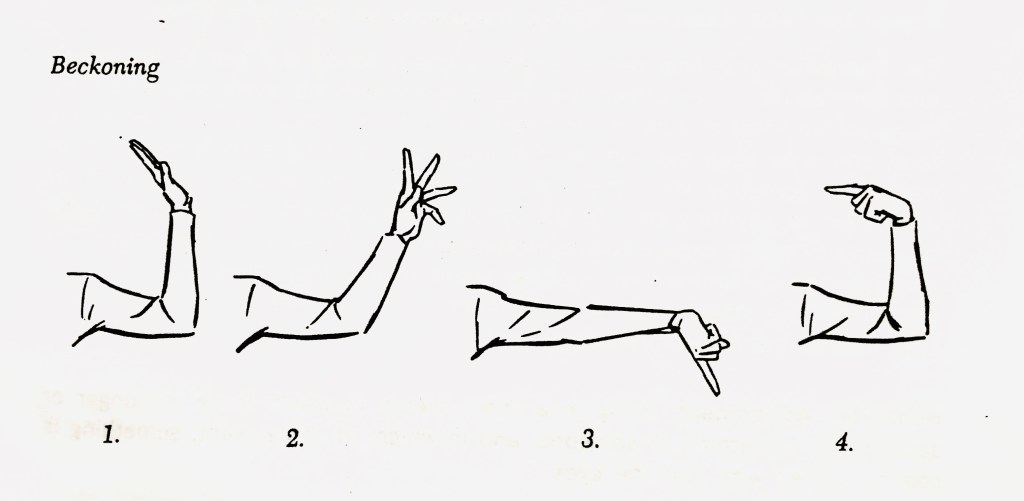
Beckoning-
push the palm towards what you will beckon, and as the elbow straightens, close, in turn, the little finger and the next two, closing the thumb on them, and drop the wrist back as you turn the arm over. The elbow is straight, the index finger is extended, and the wrist is bent back toward the floor. That is move 1. Move 2 is to bend the elbow and wrist into a beckon. Do it several times with each arm in several directions. Try first pointing, and then dropping the wrist back, and then beckoning. Try extending the beckon so that you end by pointing to the ground in front of you. There is no one way to beckon: You can do it any way you wish; but it must always be large and clear, and done once.
Exercise on Hunger and Appetite:
This exercise is one of the most concepts in acting. First, without discussion, each member of the group perform his own version of hunger, and his version of appetite. He should say which he is doing first, nor should there be any guessing until ever has done his. There should be no eating in any of these improvisations’ the physical expressions of hunger and appetite differentiated from each. By the time all have done them, a pattern will probably be seen to have to Hunger is in the stomach: It is an inner organic emptiness that needs tot filled. Appetite is in the eyes and the mouth. Hunger has to do with an appetite with a want. Most plays are concerned with the needs and wants of it! characters. Most characters are involved, on an inner level at least, with their needs and wants. Now, have a girl stand in the center of the stage area, and have one of the men in the group feel hunger for the girl, walk to her, and without touching, say some line of dialogue that has no relationship to his feeling. The girl is to remain indifferent. He is to feel an inner organic emptiness that only she could fill, while he says something like, “I went to the store and bought two yellow bulbs and two blue ones" or “Uncle Jed has gone over the hill again." Then let him try the same line of dialogue while feeling appetite for the girl: walk to her, perhaps look her over, and say the line. They are two different scenes, and neither of them has anything to do with the words that are said. Now have them switch places, and let the girl do the exercise with different dialogue. Each member of the group should do each part. There are many scenes in plays where this kind of thing takes place: where there is talk going on, but the scene is really about the relationship between the two people and their feelings for each other; such as when the young man meets the princess in Call Me Madam and they argue about the Grand Dutchy of Lichten. burg, they are really needing each other, feeling hunger for each other. This exercise, if applied to scenes, can give dimension to the performance.
Repeat the Facial Exercises:
All five expressions we have done so far.
Eye Improvisations:
One person sits in a chair, facing the rest of the group, and back about ten or fifteen feet. He is to use only his eyes, and is to com. municate an idea, a story, or an event. He is to try not to use the rest of his face, and is to keep his body still. It might be watching a sporting event, on waiting for someone who either does or does not come, or seeing an insect, .. a monster, or anything else. As the people in the group do this exercise, be seen how much can be communicated with just the eyes, and pernapoio doing it, the performers will not be afraid to use their eyes in an ole fashion on the stage. It is quite dramatic. Now look at the homework assignment.
Homework Assignment:
Bring in a short sketch in which there is hungen appetite for something or someone, and in which, at some point, something is communicated with just the eyes.
 Julien's Art Works