
The body as a unit: forward and side tilts; unit knee bends; scale-fulcrum tilts; sways; walks; being drunk; im. provisations with the body as a unit.
In this series of exercises the body is used as one rigid piece, and the only things that change are the legs and feet, and the weight; from the head to thi pelvis the body is kept tightly in line in one piece, as if it were made of piece of wood.
Tilts:
Keep the double-zero position, and tilt to the right, keeping in line with the left leg, and trying not to break at the waist. Do not keep the top half of the body upright-keep it in line with the rest. Now tilt back to the center, and then to the other side.
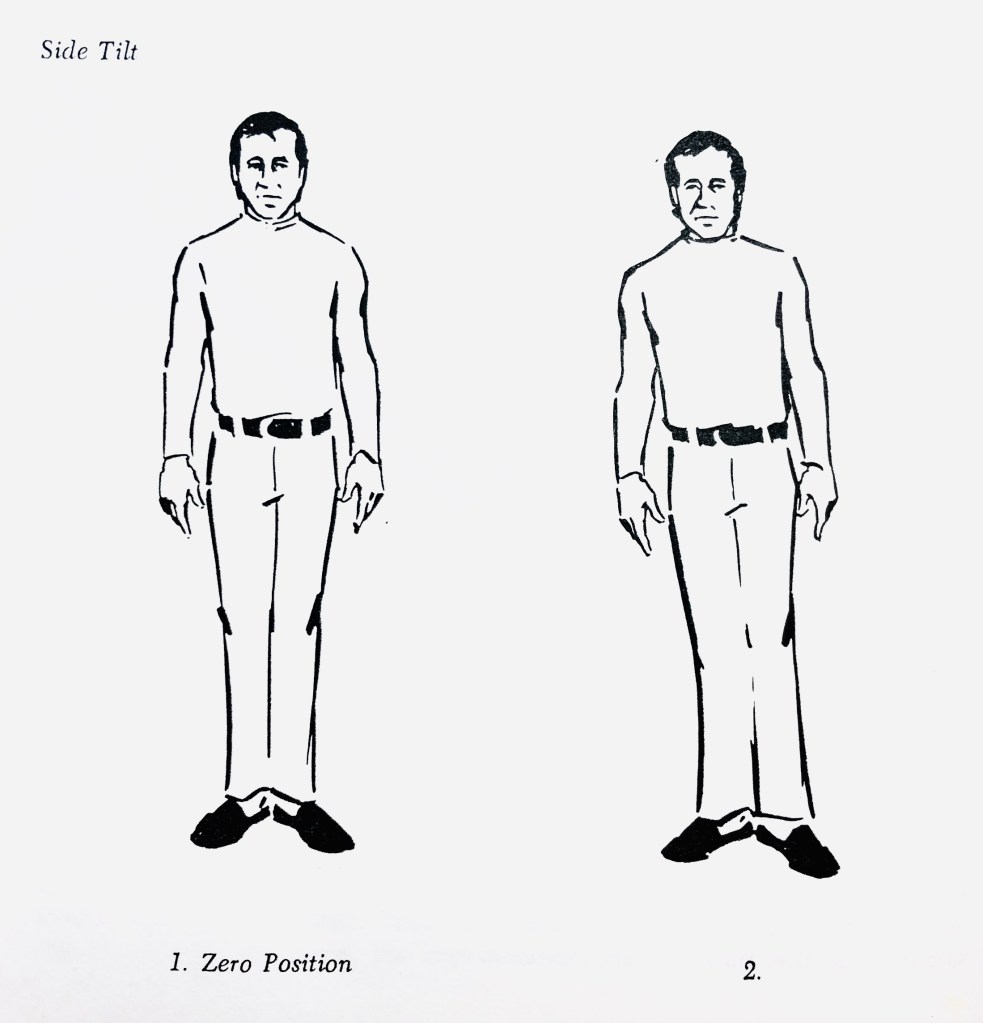
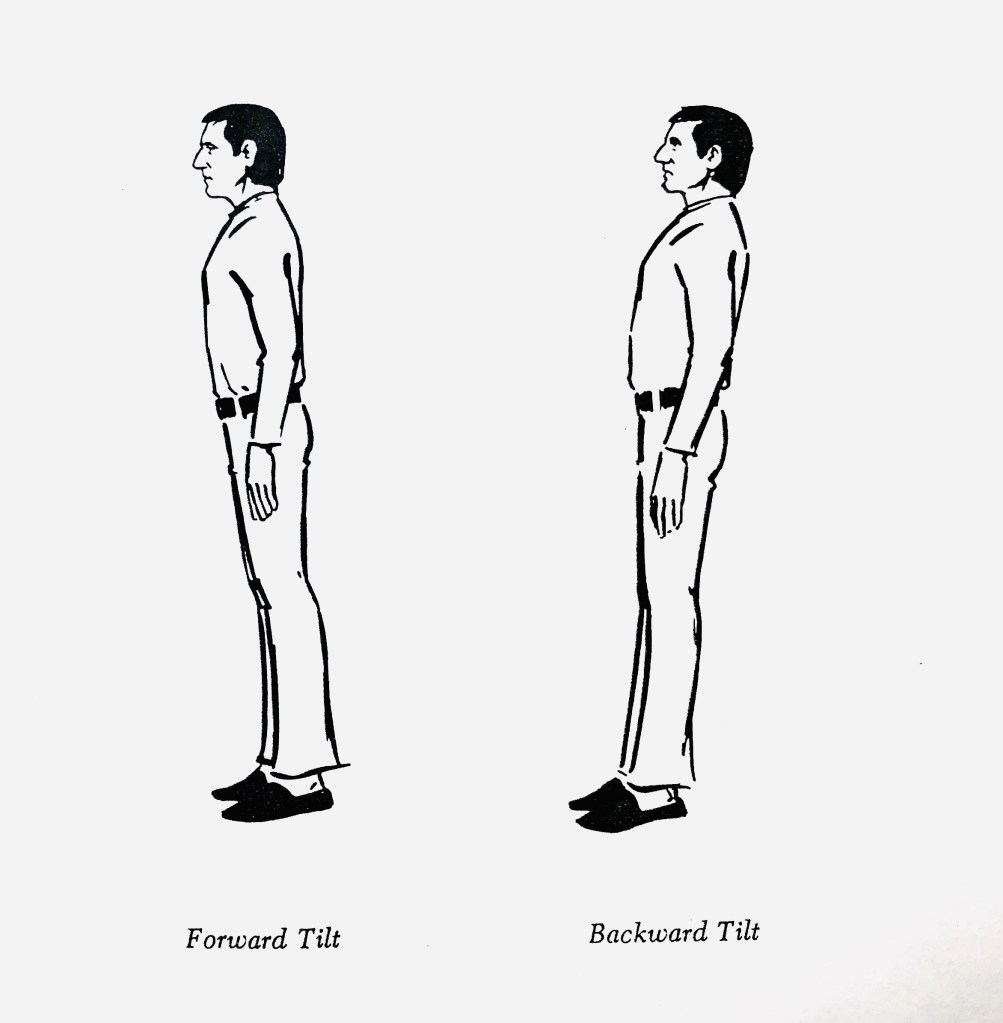
Close the toes until they are three inches apart, and open the heels about an inch, but otherwise maintain the double-zero position. Now tilt forward and back, being sure not to break at the waist. The head will tend to remain upright: don’t let it-the whole body, in line, should tilt forward.
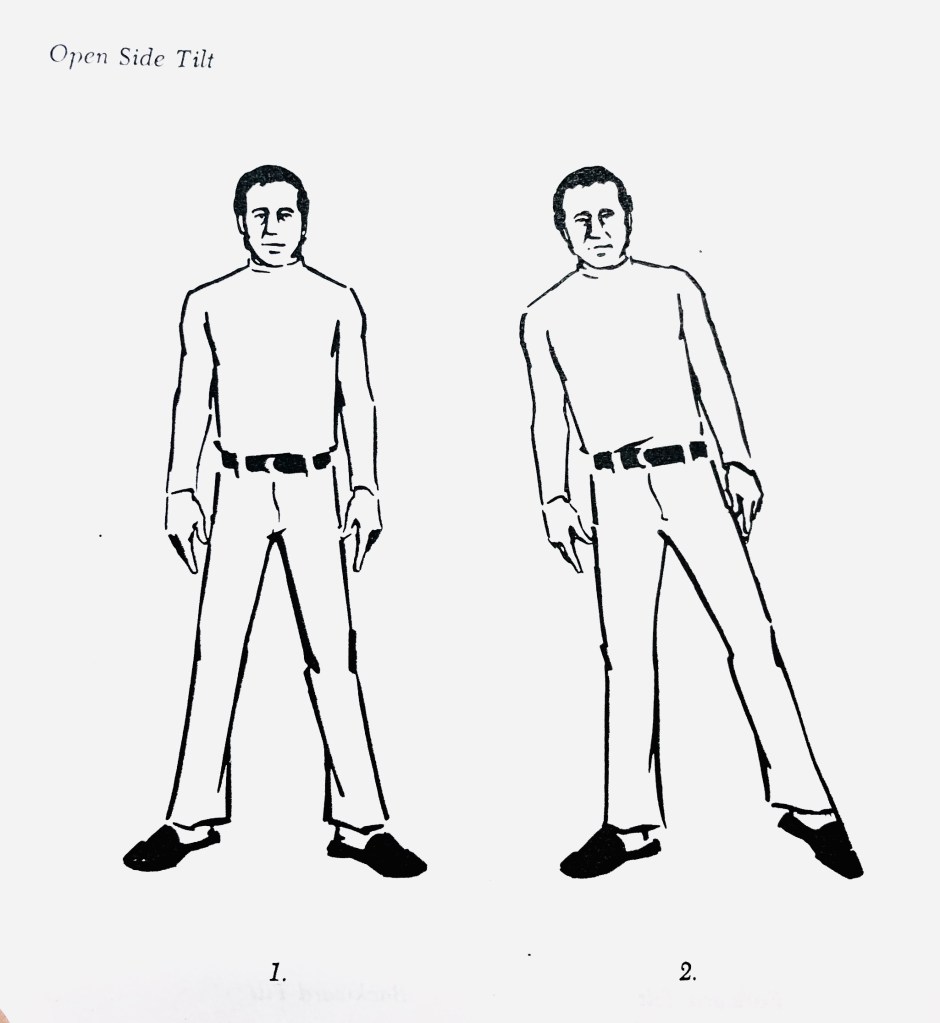
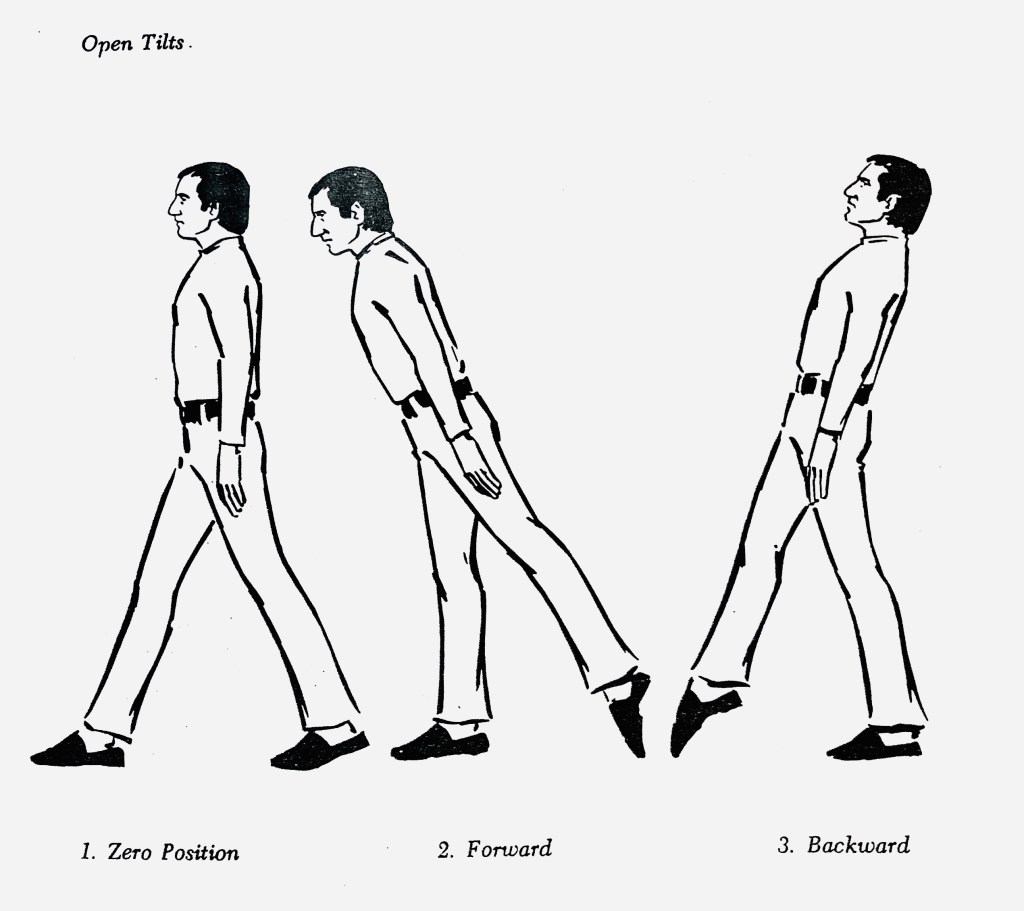
Double-zero position. Step open to the side, so that there are about fourteen inches of space between your heels. Now point to the left toe, and let it tilt the body over to the right, with the body in line with the left leg. Do not break at the hip. There will be a tendency to keep the upper body upright. Don’t. Keep it in line, and keep the head in line. Then tilt back to the center. Now point the right toe, and let it tilt the body to the left. Do this back and forth many times. being sure to remain rigidly in line with the opposite leg. Now come back to the double-zero position and step forward about fourteen inches so that one foot is in front of the other and the weight is between them. Don’t turn the feet out. Point the back toe, and let it push the body so that you are tilting forward, and looking toward the floor. Keep in line; don’t break at the waist, head in line looking towards the floor. Back to the center. Now point the front toe, pushing the body back. Keep both knees straight on all of these tilts in all their directions. Do it several times, and then switch feet, and do it again. Stay rigid from the top of the head down.
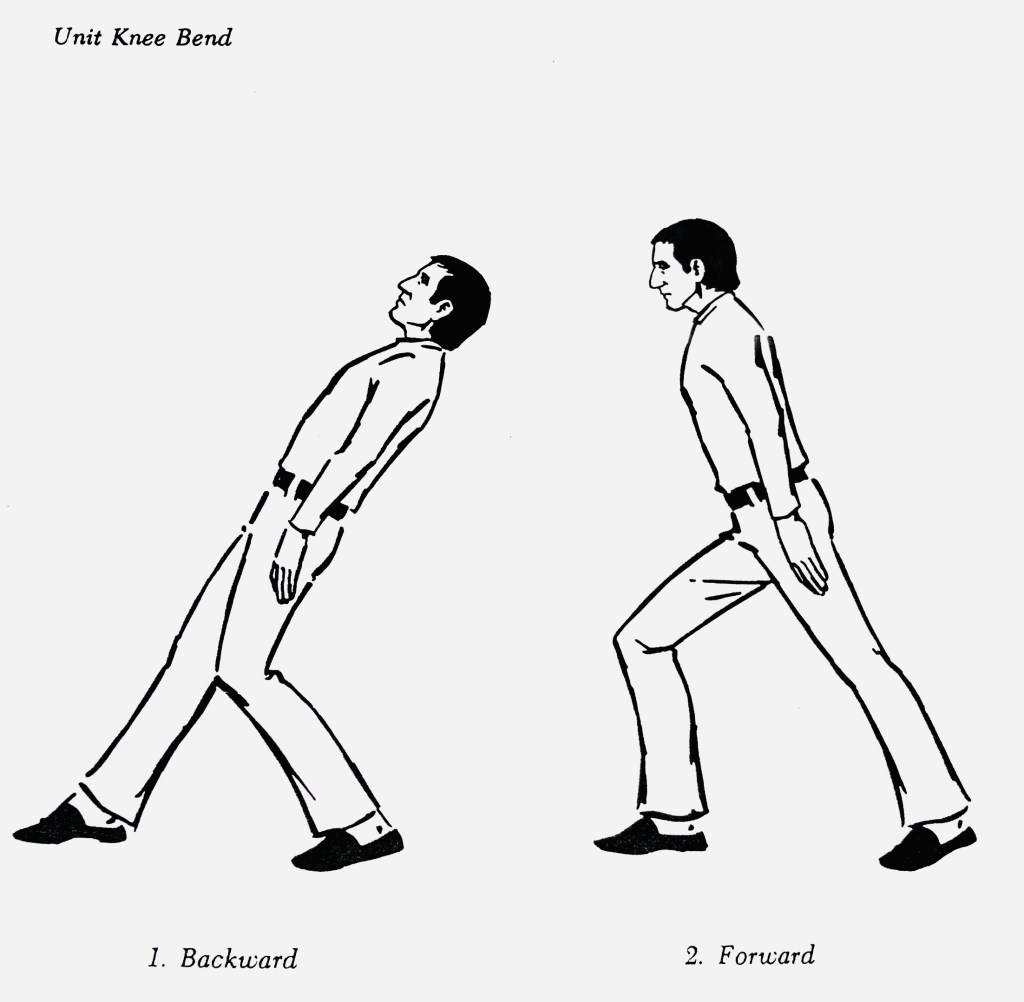
Unit Knee Bends:
Double-zero position. Step open to the side, as you did for the titls, but open your feet further. Stay upright, with the weight in the middle. Now, just bend the right knee. Do not break at the waist, and the body will tilt over to the right, on an angle that is in line with the left leg. Keep the head in line with the body. Do this over and over, and then on the left side. Now go back to the double-zero position, and step forward on the right foot, weight in the middle: a longer step than you did for the tilts. Don’t turn the feet out. Now, bend the front knee, letting the body fall forward, and keeping it and the head in line with the back leg. Both heels stay on the floor. Up to the center. Do it many times, and then try bending the back knee, letting the body fall back a bit, everything in line with the front leg. Then, after doing this several times, alternate the forward and back ones. Now change feet, and go through it all again.

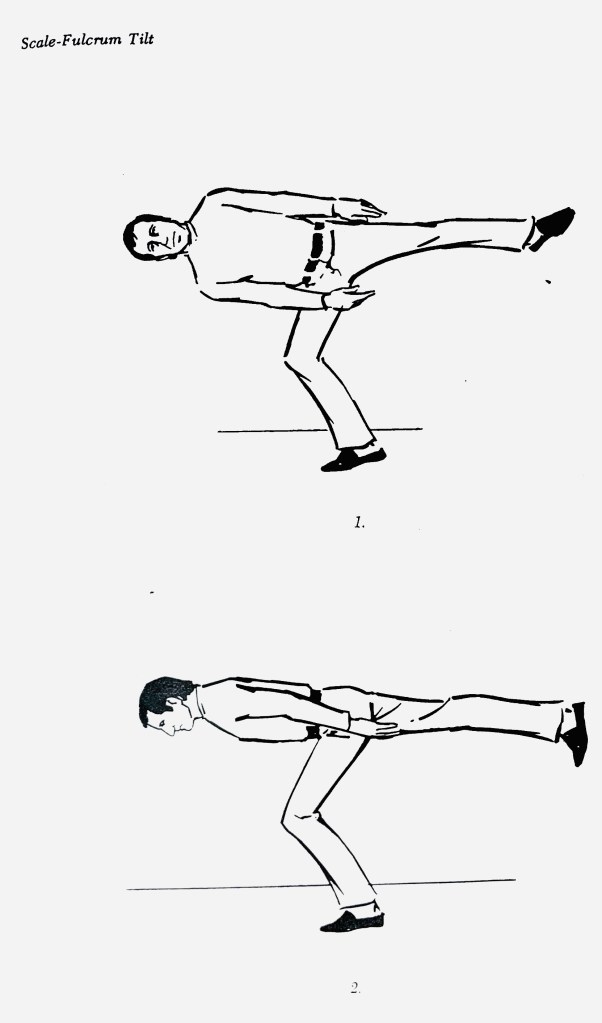
Scale-Fulcrum Tilts:
Double-zero position. Step open to the side. Tilt to the right, both legs straight, left toe pointed, body in line with the left leg, all the weight on the right. This is the starting position, and the finishing position. Put the arms along the body, one on each side of the left leg and keep them there. Now, using the body like a scale, with the right leg as the fulcrum, tilt over, lifting the left leg, and allowing the body to tilt over more. Then come back to the starting position. Then do it again, and go further. Keep both knees straight, and the body rigidly in line with the left leg. Only lift the left leg as far as the body goes over to the right; only go over with the body as far as the leg lifts. Don’t try to go so far that the body breaks its line. Be sure the head stays in line with the body. When you get tired, try it on the other side.

Now go back to the double-zero position. Step forward on the right foot. weight between both. Point the left toe, tilting the body forward, body in line with the back leg, arms pointing back in line with the back leg. This is the starting and finishing position. Tilt the body over further, lifting the back leg, and keeping the body in line with it. Keep both knees straight. Back to the starting position Do it many times, trying to tilt further, but not breaking the line of the body. When you get tired, try it with the other leg forward. Then do it to the rear, body tilted back, and in line with the front leg. You won’t be able to tilt as far as to the rear. Tilt only as far as you can. Keep both knees straight on all of these, This next group starts in the same position: tilted to the right, body in line with the left leg, arms at the sides of the left leg, weight on the right. Now, as you tilt over, lifting the left leg, and tilting the body to the right, bend the right knee, and reach the left leg further to the left. You will be able to tilt much further over than you could when the right knee was straight. The further to the left you pull the left leg, and the deeper you bend the right knee, the further towards parallel you will get. Do this on the other side. Now use these movements to pick something up, like a basket, on each side. Now do it front and back. Step forward, tilt forward, and as you tilt forward, bend the standing knee, reaching the tilting leg back further, and keep the body in line. Use this movement to pick something up. Do it on the other side. Now to the rear. Tilt back. foot forward, and bend the back knee, reaching forward with the front leg as you go back. Now do it standing on the other leg. Try to keep the head in line with all of these: It will tend to remain upright, lifting as you go forward and dropping forward as you go back; don’t let it.
All of these scale movements can be applied to moving or picking up obie, t gives a longer, more graceful line to the body, and provides clearer munication by being bigger. You can use them in your improvisations to now on, if you want them, and if they fit the character you are playing. Sways: From the double-zero position tilt to the front, the side, and in all the directions of the compass. Now try to keep rigidly in line while you sway around in a circle. Now go the other way. Try to stay in line, and not to lead with your hips. Lead with your head.
Walks:
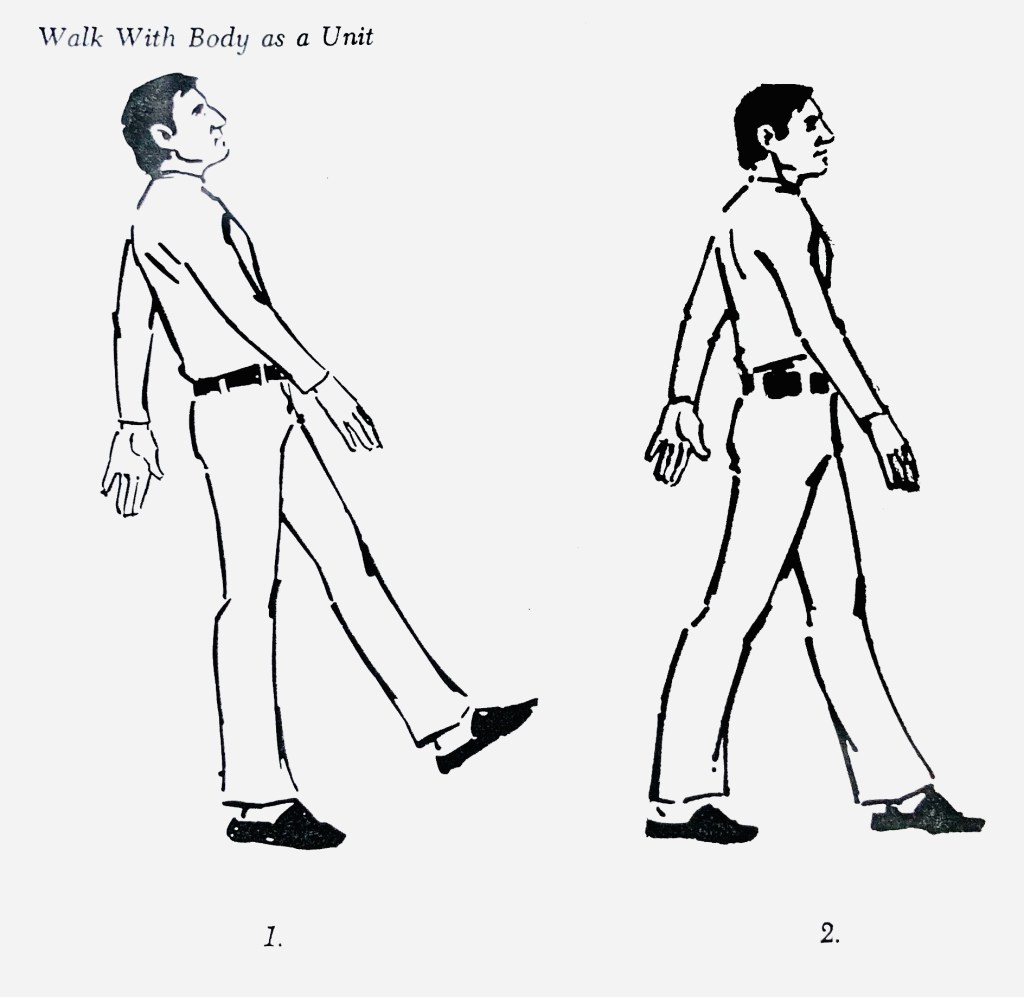
The tin-soldier walk. Stand on your right foot with the left leg extended in front of you, with the foot flexed, and the body leaning back, in line with the raised leg. Both knees stay straight in this walk. Put the right arm forward and the left one back. As in walk #1, there are two moves: (1) step onto the left foot, putting all the weight on it, and bring the body upright. Do not move the arms on the step. (2) Change the leg and arms, so that the right leg is in the air in front, foot flexed, the body leaning back in line with it, the left arm is now forward and the right back. Continue. Be sure you do not move the arms on the step only on the change. The body leans back, with the head in line with it when the foot is raised in front, and is upright when you step forward. You never really lean forward. Practice it very slowly, and when it is right, see how fast you can do the walk.
The stiff shuffle. Clasp your hands in front of you. Keeping the knees straight and the body rigid, shuffle the feet forward in tiny very quick sliding steps. When you do this walk, move in straight lines, and make square corners in your movement pattern. Be sure you keep your heels on the floor with this walk. The only time you would use either of these walks in a performance would be if the character you are portraying would walk in this very stylized mannersuch as a wind-up toy.
Being Drunk: Drunkenness is based on the sway, and overcompensating for swaying too far. It is not based on a stagger. If you stagger, it is because you have swayed, overcompensated much too far, and so have lost your equilibrium. Sway, pull back as a recovery, and go too far in the opposite direction, which makes you pull back again. When you are drunk and walk towards someone, you are slightly off balance, so you don’t aim right: You see you are going to . miss them, so you sway towards them, but you go too far, so that now you will miss them in the other direction. Now, the real trick with all of this, is to try to appear sober while doing it. The drunk never tries to look drunk. He tries not to sway, tries to maintain his balance. The more you try not to show the sway and the lack of balance, the drunker you will look. Do it subtly. Improvisations with the Body as a Unit: Handle objects, be some place, do some action, but don’t break the line of the body. If you have to lean forward, let one leg go back, if you have to pick something up, do a tilt, etc. Homework Assignment: Bring in a sketch in which the body is kept as a unit.
 Julien's Art Works